fuelpace

Know what to carry out of every aid station.

Fuelpace plans your pace and your fuel together, from the organiser’s GPX: how long each segment will take you, the margin you keep on every cutoff, and what goes in your pack, your drop bags and your stomach.

Plan a race. It’s free How the plan fits together

Leg by leg

Scroll through the same race, one leg at a time: the terrain, the clock, the cutoff and every gram you carry. All of it comes out of one plan.

Example plan · Trail des Aiguilles 32K (demo course) · 5:30 target · 70 g carbs an hour
  1. Start → Col de Balme

    12.0 km+1,158 m

    2:27

    Carry 3 bottles · 3 gels · 1 salt capsule

    Leave 2:28 · cutoff 3:15 +47 min

  2. → Vallorcine

    8.0 km−931 m

    0:49

    Carry 1 bottle · 1 gel · 1 salt capsule

    Leave 3:27 · cutoff 4:30 +1 h 2 min

  3. → Aiguillette

    6.0 km+620 m

    1:20

    Carry 2 bottles · 1 gel

    Leave 4:51 · cutoff 5:00 +9 min, tight

  4. → Finish

    6.0 km−631 m

    0:38

    Carry 1 bottle · 1 gel

    Finish 5:30

Leg 1 of 4 · Climb

Start → Col de Balme

06:00 → 08:27

2,191 m1,035 m

When to take it

  1. Bottle0:10
  2. Gel0:31
  3. Salt0:52
  4. Bottle1:13
  5. Gel1:34
  6. Bottle1:55
  7. Gel2:16
Coloured by gradient every 500 m

Terrain

Distance
12.0 km
Climb
+1,158 m
Descent
−2 m
Average grade
+9.6 %
Steepest 200 m
+19.3 %
Elevation
1,035 → 2,191 m

Timing

Leave
06:00 0:00 into the race
Arrive
08:27 2:27 into the race
Leg time
2:27:29
Average pace
12:17 /km

Fuel on this leg

Carbs
172 g needed · 195 g carried
Fluid
1,229 ml needed · 1,500 ml carried
Sodium
1,229 mg needed · 1,450 mg carried

Carry 3 bottles · 3 gels · 1 salt capsule

Packed at the start 3 bottles · 4 gels · 2 salt capsules

At the next aid station · Col de Balme

Cutoff
09:15
Leave
08:28
Planned stop
1 min
Margin
+47 min comfortable
  • Drinks only
  • No drop bag
  • No crew

Leg 2 of 4 · Descent

Col de Balme → Vallorcine

08:28 → 09:17

2,191 m1,260 m

When to take it

  1. Bottle0:08
  2. Gel0:24
  3. Salt0:41
Coloured by gradient every 500 m

Terrain

Distance
8.0 km
Climb
0 m
Descent
−931 m
Average grade
−11.6 %
Steepest 200 m
−25.7 %
Elevation
2,191 → 1,260 m

Timing

Leave
08:28 2:28 into the race
Arrive
09:17 3:17 into the race
Leg time
0:49:28
Average pace
6:11 /km

Fuel on this leg

Carbs
58 g needed · 65 g carried
Fluid
412 ml needed · 500 ml carried
Sodium
412 mg needed · 650 mg carried

Carry 1 bottle · 1 gel · 1 salt capsule

Taken at the aid station 1 bottle

At the next aid station · Vallorcine

Cutoff
10:30
Leave
09:27
Planned stop
10 min
Margin
+1 h 2 min comfortable
  • Nothing served
  • Drop bag waiting
  • Crew allowed

Leg 3 of 4 · Climb

Vallorcine → Aiguillette

09:27 → 10:48

1,880 m1,260 m

When to take it

  1. Bottle0:13
  2. Gel0:40
  3. Bottle1:06
Coloured by gradient every 500 m

Terrain

Distance
6.0 km
Climb
+620 m
Descent
0 m
Average grade
+10.3 %
Steepest 200 m
+22.5 %
Elevation
1,260 → 1,880 m

Timing

Leave
09:27 3:27 into the race
Arrive
10:48 4:48 into the race
Leg time
1:20:20
Average pace
13:23 /km

Fuel on this leg

Carbs
94 g needed · 105 g carried
Fluid
669 ml needed · 1,000 ml carried
Sodium
669 mg needed · 750 mg carried

Carry 2 bottles · 1 gel

From your drop bag 2 bottles · 1 gel

At the next aid station · Aiguillette

Cutoff
11:00
Leave
10:51
Planned stop
3 min
Margin
+9 min tight
  • Food and drinks
  • No drop bag
  • No crew

Leg 4 of 4 · Descent

Aiguillette → Finish

10:51 → 11:29

1,880 m1,249 m

When to take it

  1. Bottle0:09
  2. Gel0:29
Coloured by gradient every 500 m

Terrain

Distance
6.0 km
Climb
0 m
Descent
−631 m
Average grade
−10.5 %
Steepest 200 m
−20.1 %
Elevation
1,880 → 1,249 m

Timing

Leave
10:51 4:51 into the race
Arrive
11:29 5:29 into the race
Leg time
0:38:43
Average pace
6:27 /km

Fuel on this leg

Carbs
45 g needed · 65 g carried
Fluid
323 ml needed · 500 ml carried
Sodium
323 mg needed · 400 mg carried

Carry 1 bottle · 1 gel

Taken at the aid station 1 bottle · 1 gel

Finish · 11:29

Finish line: no cutoff, no stop.

Pace and fuel come out of one plan

Pacing apps tell you when you arrive. Fuel calculators tell you how many grams an hour. Fuelpace joins them, so every change to your race shows up in your pack.

2 h 27 The climb sets the load
Start to Col de Balme is 12 km and 1,158 m of climbing: about two and a half hours at 12:17 per kilometre. At 70 g of carbs an hour, you leave the start line with three bottles, three gels and a salt capsule for that leg alone.
Drinks only Each station refills what it serves
Col de Balme serves drinks, so you refill one bottle there. Vallorcine serves nothing, so your drop bag waits there with two bottles and a gel. Aid stations, refreshments and drop bags come from the race’s own information.
+9 min Margins you can act on
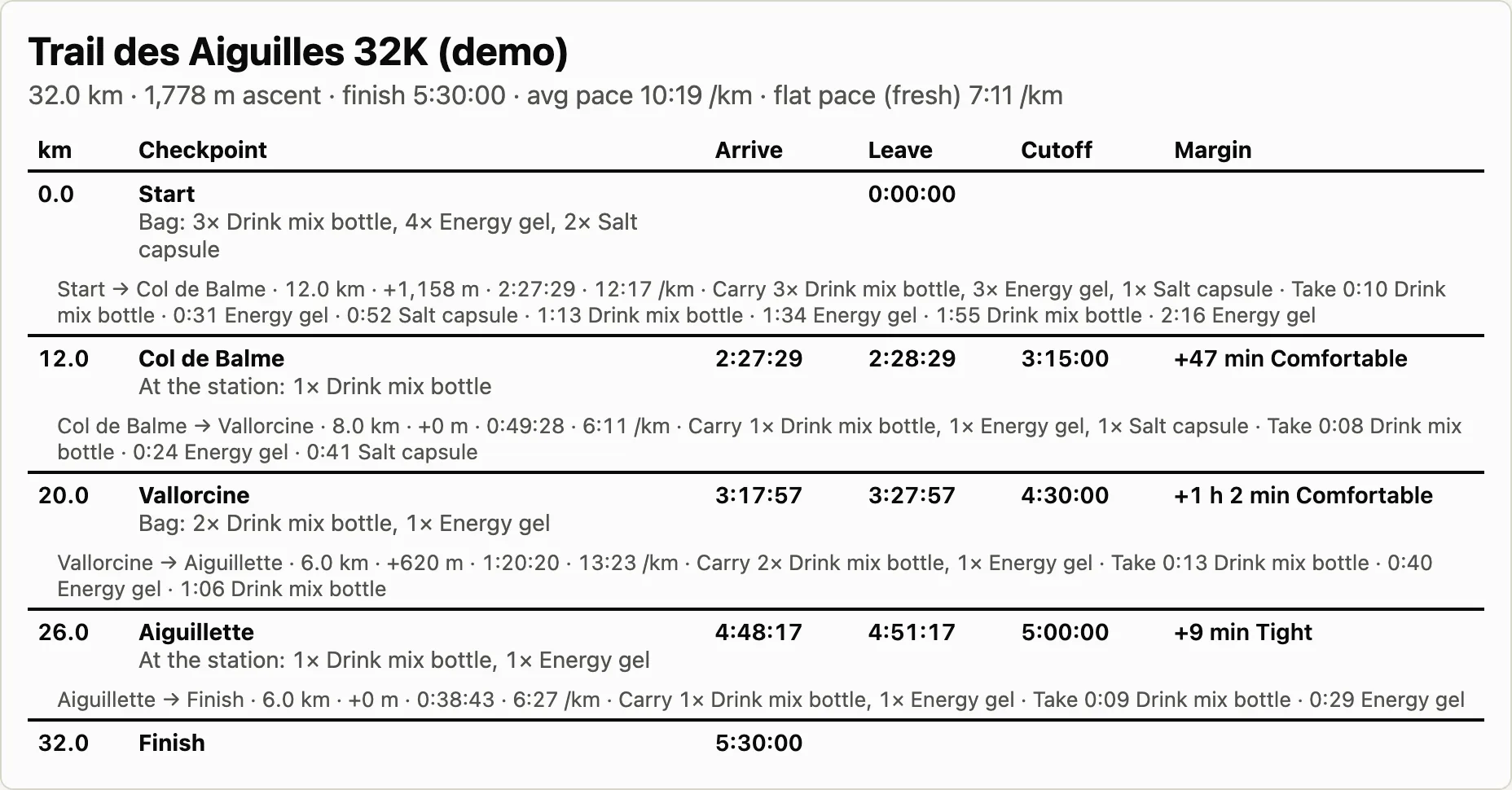
Leaving Aiguillette at 4:51 against a 5:00 cutoff is flagged as tight. Change your target time or your stops, and the splits, the margins and the fuel plan all follow.

Print it. Pack it.

One sheet with arrival, departure, cutoff and margin at each aid station, plus what to take on every segment and when to take it. It works without signal or battery, and without a phone in your hand.

The Trail des Aiguilles race card: each aid station with arrival, departure, cutoff and margin, and under each segment what to carry and when to take it.

From GPX to start line

  1. Upload the course

    The GPX the organiser publishes. You get the profile, the map and the segments.

  2. Add the aid stations

    Their cutoffs, what they serve, where your drop bags and your crew wait.

  3. Set your pace

    A target finish time or a flat pace. The plan adjusts for gradient and fatigue.

  4. Choose your fuel

    Your drinks, gels and salt, and how much you take an hour. Then print the card.

Your next race, planned tonight.

Free, with open sign-up. In English and French.

Plan a race